
August 2nd, 2021
AQT quantum computers now supported by HQS Quantum Simulations backend
August 2021: AQT’s trapped-ion quantum computers are now supported by the HQS Quantum Simulations backend
HQS extends the open source quantum computing library qoqo and allows developers to run their quantum algorithms on AQT’s simulators. This is the first step on the way to granting access to the AQT quantum computers in the near future.

The steady development of quantum technologies is bringing their promise closer and closer to the market, as companies around the world aim to deliver their quantum enhanced solutions to the general public. In a bid to allow developers everywhere to participate and use quantum computers, HQS Quantum Simulations has announced the release of a library connecting its open source quantum computing library, qoqo, to AQT’s quantum simulators, with an intended complete support of their trapped-ion quantum computers in the future.
As the physical limits of conventional computing are starting to appear in many R&D labs around the world, quantum computing is considered to be the natural way forward for resource-intensive tasks that are currently pursued using high performance computing (HPC) clusters: physical, chemical, and manufacturing simulations are all expected to move on to quantum computing in the coming decades.
Yet, the path ahead is rife with obstacles, as experimental realizations of quantum bits, or qubits, the fundamental components of quantum computers, are notoriously difficult to achieve. The useful quantum properties of qubits are fragile and very easily lost when they are exposed even to the tiniest disturbances in their surroundings, leading to the phenomenon known by physicists as decoherence. Currently, various hardware approaches are pursued to realize inherently resilient qubits. Quantum computers based on trapped ion technology are promising in various respects: compared with other architectures, trapped ion quantum computers have a strong advantage when it comes to qubit connectivity, and gate fidelity. Ion traps have been central in the pioneering of several milestones in quantum information processing and they have become the platform on which the most complex quantum algorithms have been performed; the team at AQT has made several contributions to these outstanding achievements.
qoqo is a quantum circuit representation library developed by HPQ Quantum Simulations, which empowers developers to build quantum circuits and run them on different backends. With the connection of AQT’s technology to qoqo, users are now able, without any modification to their existing circuits, to run them on AQT’s quantum simulators, both with and without noise. This marks a helpful technical accomplishment and a sound stepping stone for the future implementation of AQT’s quantum hardware as a qoqo backend.
© Photocredits: Dieter Kühl
October 14th, 2026
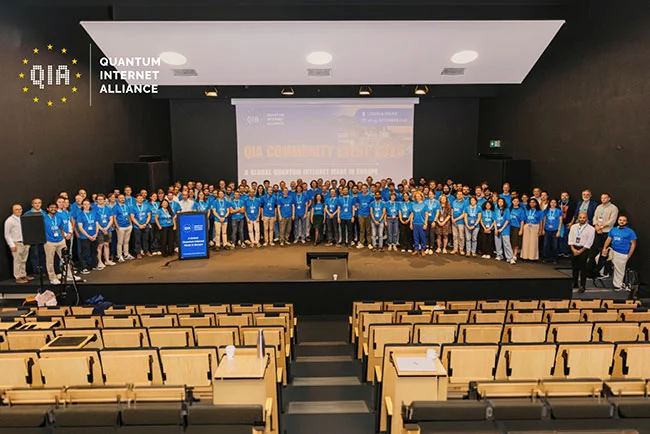
The Quantum Internet Alliance receives Euro 47.5 million to build a full-stack quantum internet prototype, with AQT contributing trapped-ion hardware as a partner.

October 2nd, 2026
We’re happy to inform about the launch of our Product Finder. The new tool makes it easier to quickly explore the available options and identify instruments that match the requirements of your needs.
September 29th, 2026
AQT Germany will be one of the seven members in the consortium of research institutions and industry partners in a bid to build one of Europe's most advanced quantum computers.