
August 30th, 2019
AQT co-founder is awarded Bell Prize
August 2019: We are delighted to announce that AQT co-founder Peter Zoller receives the John Stewart Bell Prize for his outstanding achievements in the field of quantum information processing.
The fourth biennial John Stewart Bell Prize for Research on Fundamental Issues in Quantum Mechanics and Their Applications is awarded to Peter Zoller and his long-term collaborator and AQT board member Ignacio Cirac (Max Planck Institute for Quantum Optics) for their recent groundbreaking proposals in quantum optics and atomic physics on how to engineer quantum systems to carry out novel information processing tasks, in particular for extending the applications of quantum simulators to lattice gauge theories, showing how long range entanglement can be estimated via statistical measurements, and using Projected Entangled Pair States for the theoretical study of quantum many body systems.

The Northern Irish physicist John Stewart Bell is best known as the originator of Bell’s theorem, which is seen as the fundamental test to prove the validity of quantum mechanics theory. The prize named after him was established in 2009 and is awarded every two years since 2009 by the Centre for Quantum Information and Quantum Control at the University of Toronto for major advances in quantum physics. Among the previous winners is another co-founder of AQT, Rainer Blatt, who received the prize in 2015.
October 14th, 2026
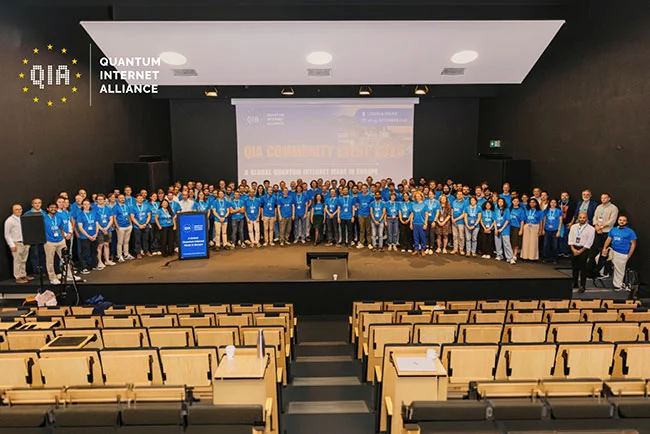
The Quantum Internet Alliance receives Euro 47.5 million to build a full-stack quantum internet prototype, with AQT contributing trapped-ion hardware as a partner.

October 2nd, 2026
We’re happy to inform about the launch of our Product Finder. The new tool makes it easier to quickly explore the available options and identify instruments that match the requirements of your needs.
September 29th, 2026
AQT Germany will be one of the seven members in the consortium of research institutions and industry partners in a bid to build one of Europe's most advanced quantum computers.